
Road Safety Body of Knowledge Introduction
Abstract
Impetus for the development of a Body of Knowledge for road safety emerged from realisation that in the context of deteriorating road safety in many countries, building capacity for road safety and increasing professionalism in those working in the area has only rarely been employed as a road safety strategy. This Chapter explains the rationale for development of a Body of Knowledge for road safety and provides an overview of the approach being used. A Body of Knowledge will provide the framework for education, training and certification and accreditation programmes for professionals/practitioners working in the field of road safety. The approach to developing this Body of Knowledge is based on that used in occupational health and safety which has been highly successful in increasing the status and professionalism in that field. The Road Safety Body of Knowledge takes a transdisciplinary approach, integrating the different disciplines that currently contribute to road safety to construct new frameworks and knowledge about road safety to go beyond these narrower disciplinary perspectives. This aims to encourage broader ways of thinking about road safety for new road safety professionals and for those who may have been working in the field for some time so helping to avoid complacency in approaches to road safety problems. Building capacity is a primary role of a professional society such as the Australasian College of Road Safety. It will target members already working in the field to develop a broader range of strategies to improve road safety and provide members new to the field with the knowledge to achieve high quality road safety.
The Australasian College of Road Safety (ACRS), as a peak body for road safety professionals recognised the need to build capacity for professionals working in the field of road safety as part of the arsenal of strategies to address the difficult problem of reducing crashes, deaths and serious injury on our roads all around the world. The ACRS initiated a capacity building project in early 2024, with funding from the Australian Federal Government. The essential first stage of this project is to develop a Body of Knowledge for road safety which defines the scope of knowledge needed for a practicing road safety professional. Even though a defined Body of Knowledge exists for many other fields of knowledge, it is currently absent for road safety.
The objective of this first chapter in the Road Safety Body of Knowledge is to explain the need for new approaches to road safety and why a common knowledge base should be a prerequisite for building the professional capacities of a road safety professional. The chapter then goes on to describe the defining characteristics of a Body of Knowledge, its scope of coverage and the process of its development.
The state of road safety
The current state of road safety in Australasia and internationally is concerning. Around the world, road crashes too often shorten people’s lives and are responsible for the highest proportion of deaths involving people in their most productive years. Globally, two-thirds of deaths occur among people of working age (18– 59 years), causing huge health, social and economic harm throughout society. (WHO Global report 2023). Road crashes are also responsible for serious injury which, too often, cause the injured person pain and suffering and shortens their productive life. The consequences of road fatalities and serious injuries extend to families and friends as well. Beside the bereavement effects of losing a loved one, road crashes also affect family livelihoods in many parts of the world.
The picture hasn’t always been this grim. Over the past fifty years or so, we have seen great improvements in road safety in many countries. Since the early 1970’s, initiatives like mandatory seat belts, random breath testing, improved vehicle design and better road design have led to marked reductions in road fatalities in Australia and New Zealand and many other high-income countries. Unfortunately, for the last decade we have seen little change in the number of road fatalities or serious injuries in these countries. In fact, over the last few years in Australia trends have been reversing with increases in road-related fatalities and serious injuries and similar changes in other countries. Perhaps the long period of improving road safety led to a degree of complacency about road safety or maybe we have inadvertently solved the easy road safety problems and now need to tackle the more difficult ones? Over and above this, road crashes remain an acute problem in low- and middle-income countries, accounting for over 90% of global road fatalities (WHO, 2023).
In addition, we need to acknowledge that road safety is a dynamic issue, influenced by factors like changes in road use patterns brought about by broader socio-cultural change. Many of our past successes in road safety focused on improving the safety of vehicle occupants (particularly cars). Currently, the growth in active transport and micromobility (e.g. scooters) means that the nature of the road safety problem is evolving in different directions. Our road safety efforts must be responsive to these types of changes, and they highlight the need for ongoing education and training of road safety professionals. These influences, in combination with the current stagnation in road deaths and injury, certainly indicate a need to review what collective knowledge should be shared by road safety professionals as a basis for understanding the causes and management of road safety problems and how we can ensure that road safety professionals have access to it.
Understanding the sources of the problem
Views abound on the best approaches to solving our road safety problems and there have been several reviews of the best road safety countermeasures including from the US Federal Highways Administration (https://highways.dot.gov/safety/proven-safety-countermeasures) and the World Bank’s Guide for Road Safety Interventions: Evidence of what works and what does not work (Turner et al., 2021). These reviews make it clear that not all interventions are supported by evidence of their effectiveness, even for commonly used interventions. Watson (1997) pointed out the paradox that some road safety measures popular with the general community have not proven cost-effective when subjected to rigorous evaluation. He cited three road safety measures that despite widespread community support in Australia had limited evidence of effectiveness: specialised skills-based driver training; harsher traffic offence penalties, and the isolated use of mass media road safety campaigns. Further research on these three measures over the past 25 years, has failed to produce compelling evidence that they have become cost-effective despite their popularity with the community and some decision-makers.
These reviews highlight the importance of ensuring that road safety professionals have access to the most up-to-date evidence on road safety strategies. The value of reviews such as those cited above is dependent on their currency of evidence and their availability to those who will implement these strategies. It is also notable that none of the reviews of strategies that work in road safety include strategies to advance knowledge and expertise for road safety professionals. We may be missing an opportunity to improve road safety by strengthening the knowledge and expertise of professionals working in the area.
A recent study conducted by the Australasian College of Road Safety on the career opportunities and pathways for women in road safety provided some insights into some of the missing elements in the way we tackle road safety. This was a joint project with the Australian Local Government Association and the Monash University Accident Research Centre and funded by the Federal Government. Using survey and focus group methods, the Women in Road Safety project showed consistent participant views that road safety lacks professionalism. Participants pointed to the limited availability of professional development and education specifically for road safety, with no clear entry path for those working in the area and that career progression within the area of road safety is “haphazard and ill-defined”. They also reported the view that while good road safety requires input from physical, behavioural and social sciences working synergistically, currently this happens only superficially. Participants reported that even when road safety professionals from different disciplinary backgrounds work together, road safety solutions are almost always restricted around disciplinary boundaries. These results show that current road safety professionals feel the need for greater emphasis on building professional capacity and professionalism in road safety. It reinforces capacity building as a missing element in road safety and explains why road safety outcomes would be lacking as well.
Professionalisation of road safety
While a considerable amount has been written on the characterisation of professions, a succinct definition of a profession was put forward by Professions Australia in 1997. This states that:
A profession is a disciplined group of individuals who adhere to ethical standards and hold themselves out as, and are accepted by the public, as possessing special knowledge skills in a widely recognised body of learning derived from research, education and training at a high level, and who are prepared to apply this knowledge and exercise these skills in the interest of others (Benson, 2010).
The Australasian College of Road Safety was established to be the peak professional body for road safety in Australia and New Zealand, but our members are self-defined professionals as there are no formal educational or experience-related criteria for entry. Our members come from a host of different disciplinary backgrounds, many of which are professions in their own right, such as engineering, law or medicine. As members of the College, we refer to ourselves as road safety professionals, implying that road safety is a profession, but does road safety fulfill the criteria considered to define a profession? Furthermore, although there are other organisations that represent the interests of road safety practitioners, such as the Canadian Association of Road Safety Practitioners, road safety is generally not recognised as a profession globally.
Cheetham and Chivers (2005) compiled a list of criteria for a profession from which we might judge the answer to the question of whether road safety can be seen as a profession. Their characterisation of a profession includes that it:
- confers status within society
- organises itself into some sort of professional body
- is learned—i.e., requires prolonged and specialised training and education
- is altruistic (orientated towards service rather than profit)
- offers autonomy within the job role
- is informed by an ethical code of some kind
- is non-commercial
- has collective influence within society
- is self-regulatory
- is collegial
- is client-focused.
Road safety currently can claim to fulfill almost all these criteria with one obvious exception relating to specialised training and education. As described above, people who identify as road safety professionals have training and qualifications in one of the discipline areas that contribute to road safety but tend to ‘pick-up’ road safety experience. Training in road safety is mostly in the form of courses on specific aspects of road safety. There is little training available for road safety in general which creates a real barrier to professionalism in our field. In addition, there is no commonly accepted curriculum or core content for training within the road safety field nor certification/accreditation processes in place. As a result, there is no standardisation of the training being offered or undertaken. In other words, individuals and organisations are largely left to their own devices to decide what type of training (if any) is required.
The question is how do we approach the problem of training and building capacity in road safety? Can we simply build on what we are already doing, or is the problem more complex requiring new methods and strategies for tackling specific road safety issues? Unfortunately, the evidence suggests that the simple approach is unlikely to be successful. For road safety to be regarded as a profession, there needs to be at least some form of education and training specifically addressing the fundamental knowledge required to enhance road safety. There are currently multiple barriers to achieving this including limited availability of professional development and training courses most of which are single-discipline focussed, such as safety audit training for engineers and little training for or about human behavioural aspects of road safety. Further, there is a lack of consolidated information or centralised register of road safety available about course offerings, even when they do exist.
Lack of professionalism is a problem identified in other areas of knowledge and practice, including in other areas of safety, most notably occupational health and safety. In Australia, the Safety Institute of Australia (SIA) recognised that the OHS profession was fragmented, lacked a cohesive education and training framework and was becoming marginalised (Provan and Pryor, 2019). The SIA set on a path of ‘strategic professionalisation’ with the aim of improving the capability, effectiveness and recognition of the OHS profession. Lack of an agreed core content for OHS education was identified as a major limiting factor in this path, so it became the first step in the process towards professionalisation. This process has been highly successful and has produced an OHS Body of Knowledge which is an electronic resource currently available to anyone interested. This Body of Knowledge became the basis for development of a programme of capacity building and accreditation for the OHS profession.
The problems identified for OHS mirror those we experience in road safety. As identified in the preceding discussion, fragmentation and lack of a cohesive education and training framework currently characterise road safety too. By modelling on the OHS success story, a path toward improvement in road safety could then be through establishing a Body of Knowledge for the profession and practice of road safety.
Defining the scope of the body of knowledge needed for a road safety professional
The first problem in defining the scope of knowledge in road safety is that there is little consensus on what is road safety. Participants in the Women in Road Safety project raised the central question of ‘what is road safety?’ and a key recommendation from the report was that ‘Road safety needs to define and refine its image and parameters as a united entity to become recognised as an industry’. In developing a Body of Knowledge on road safety, it is essential to clearly define the scope of collective knowledge needed to be a road safety professional. The BoK also needs to clearly articulate what our goals/objectives are for improving road safety. This is central to having a collective view on the purpose of our road safety efforts.
One of the strengths of the field of road safety, but perhaps a weakness too, is that the field is multidisciplinary. As shown in Figure 1, road safety problems can be addressed by professionals from a wide range of disciplines as diverse as engineering to education or statistics. Each of these disciplines provides inputs into the primary road safety problem of reducing death and injury around the road system. In fact, it could be argued that road safety would be poorer without the involvement of professionals from all these disciplines. For example, historically the ‘three E’s’ of road safety strategy, engineering, education and enforcement, acknowledged the need for expertise from at least three distinctly different disciplines, but of course road safety needs input from many more disciplines.
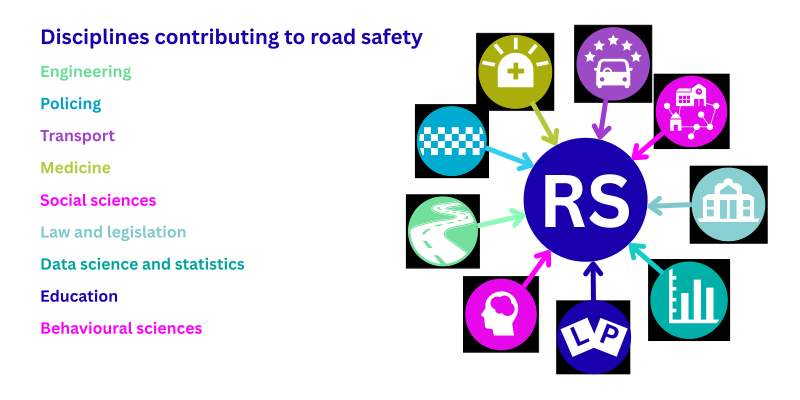
Figure 1: Multidisciplinary composition of road safety
The problem with an approach that relies on input from different disciplines, however, is the conceptualisation of solutions to the road safety problem is not the same for each discipline. For example, engineers, whose primary contribution is the design of the road environment, often see the problem in terms of poor behaviour by road users. For police, the problem relates to violation of road rules by road users, for physicians it relates to mitigating the consequences of road crashes and keeping people out of hospital, whereas educators, and behavioural/social sciences primarily focus on modifying behaviour using a range of approaches such as education, training and incentive-based programmes. In addition to having different perspectives on road safety, some practitioners have broader responsibilities that can impact on the priority assigned to safety. For example, traffic engineers are often required to balance safety considerations with efficiency and/or amenity goals, which may prove suboptimal from a safety perspective. With this range of different perspectives on the problem, it is not at all surprising that views of what is road safety differ considerably. With this range of different perspectives on the problem, it is also not surprising that practitioners can hold different views on the underlying goals for road safety and the best approaches to achieve these.
In the context of the pressing problem of managing deaths and injury on the road system, the next question might be whether the lack of a consistent view of road safety really matters. Aren’t we all here to reduce deaths and injury on roads? Can’t this group of multidisciplinary professionals just get on with doing what they each do best? Each discipline is just tackling the problem of reducing deaths and injury on roads in their own way. The problem is that without a shared view of road safety, the field lacks a cohesive focus which results in single-focus approaches or silos developing and, in turn, limits the scope of interventions. The singular disciplinary view also means there is too little awareness of other disciplinary contributions and little or no cross-fertilisation of ideas and strategies for solving road safety problems. As highlighted from the Women in Road Safety survey, we also need to clarify the scope and parameters of road safety to become recognised as a united professional entity.
Putting this together, road safety lacks a clear definition of scope and a strong, common professional focus. These problems of multiple ways of viewing road safety hampers our work on improving it and, in addition, reduces the professional status of road safety.
Addressing issues relating to multiple disciplines
The problem of managing multiple disciplines is not unique to road safety. Other professional groups have acknowledged the same problems and have taken steps to solve them. To address the difficulty associated with multidisciplinary approaches, the concept was developed of transdisciplinary approaches. This concept emerged in the early 1970’s as an extension of interdisciplinarity in response to growing concerns about the increasing specialisation and compartmentalisation of knowledge associated with the disciplines. Figure 2 depicts the distinctions between multidisciplinary, interdisciplinary and transdisciplinary approaches, showing how the disciplinary structures are incorporated into a merged structure in transdisciplinary approaches.
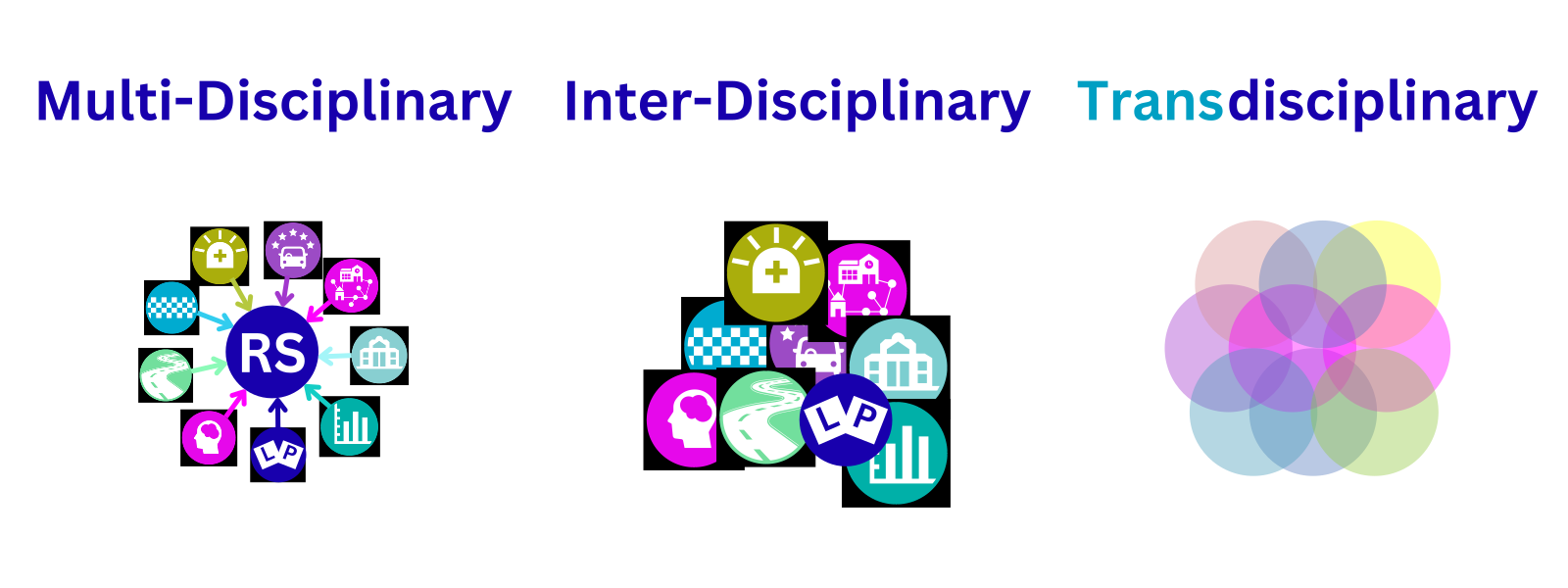
Figure 2: Comparison of multi, inter and transdisciplinary concepts
Original interest in the transdisciplinary concept was stimulated by the search for solutions to some of the very difficult or ‘wicked’ problems like climate change where answers were emerging from ‘the interface between science, society, and technology in the contemporary world’, with some taking the broader view of ‘transdisciplinarity as a theoretical unity of all of our knowledge’ (Bernstein, 2015). A Charter of Transdisciplinarity was developed in 1994. Article 3 of the Charter (shown in Box 1) describes the complementary nature of the approach which attempts to find ways to bridge the silos of disciplinary work toward more unified knowledge perspectives when addressing a problem. To move forward with a transdisciplinary approach, requires at least some basic understanding of what each discipline covers and how it frames issues relating to the core problem. Introducing a transdisciplinary approach would be particularly applicable to road safety as it would encourage thinking beyond the disciplinary silos to search for more transdisciplinary approaches to road safety problems. In the process, we could create a transdisciplinary road safety entity rather than multidisciplinary or even interdisciplinary.